

Explore Supported Spaced Fence Layouts
Choose the system and screening pattern together, with matching posts, rails, and spacing parts.
Decide How Much of the View to Keep
The best layout starts with the sightlines around the yard, not just the size of a gap.
A More Open Boundary
Spaces between boards can suit a front garden or patio edge where you want partial screening. Look through the pattern from the street, path, and seating area. Some views will remain open.


When Full Privacy Fits Better
A continuous screen may better suit a direct view into a private seating area. Compare full and semi privacy from both sides, including raised windows and changes in ground level.
Use the assembly details for the chosen material rather than transferring one spacing kit to every fence.
Compare Semi Privacy Fence Styles
Wood-Look Composite
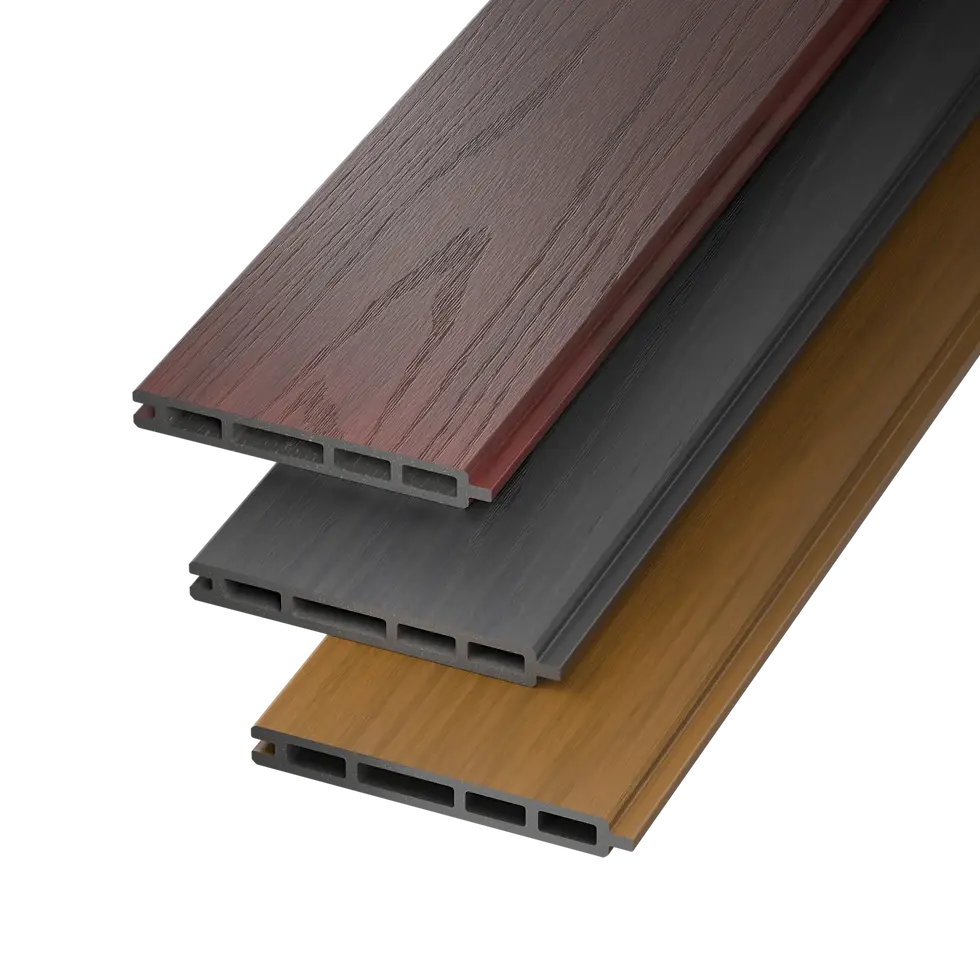
Compare Redwood, Teak, and Charcoal in the supported spaced layout. Confirm the board direction, height, and matching parts before preparing quantities.
Steel Posts with Your Wood Infill
Modern Yard offers steel posts with matching groove configurations for compatible customer-supplied wood. Review the actual infill and support arrangement; a metal slat spacer is not a universal timber connector.
Horizontal Metal Slats
The LINE horizontal slat system offers full-privacy and semi-privacy configurations. Its powder-coated Dark Gray rows create repeated horizontal lines with the matching posts and hardware.


A One-Inch Visible Gap Is Not a Groove Size
The listed horizontal spacing pack contains forty one-inch board spacers and forty groove covers for compatible assemblies. The spacing concerns the visible pattern between boards. It is different from the one-inch post-groove configuration used to fit infill. Select each by its role and the chosen system; do not use one measurement in place of the other.

Check the Pattern from Three Viewpoints
Use a sample layout to judge how the proposed spacing works where people actually look through the fence.
Seated and Standing
Compare the view at both heights. A gap that screens one sightline may leave another open.
Along the Path
Approach from different angles and distances. The repeated pattern can feel more open from one direction than another.
After Dark
Check how indoor or patio lighting changes the view. A spaced fence does not guarantee that the area behind it stays hidden.
Coordinate Sections and a Matching Entrance
Carry the selected spacing through the layout while resolving corners, slopes, and gate connections.