

Explore Vertical Composite Fence Options
Compare vertical fence systems by color, height and mounting.
Loading products…
A Vertical Pattern with a Complete Support System
Board direction determines the supporting rails and section layout.
Upright Wood-Look Boards
The upright WPC boards combine natural wood fibers with recycled plastic. Redwood, Teak and Charcoal provide three wood-look colors.


A System Built on Site
The Teak vertical full-privacy layout combines boards, steel posts and vertical rails in a nominal 8 ft W × 6 ft H configuration.
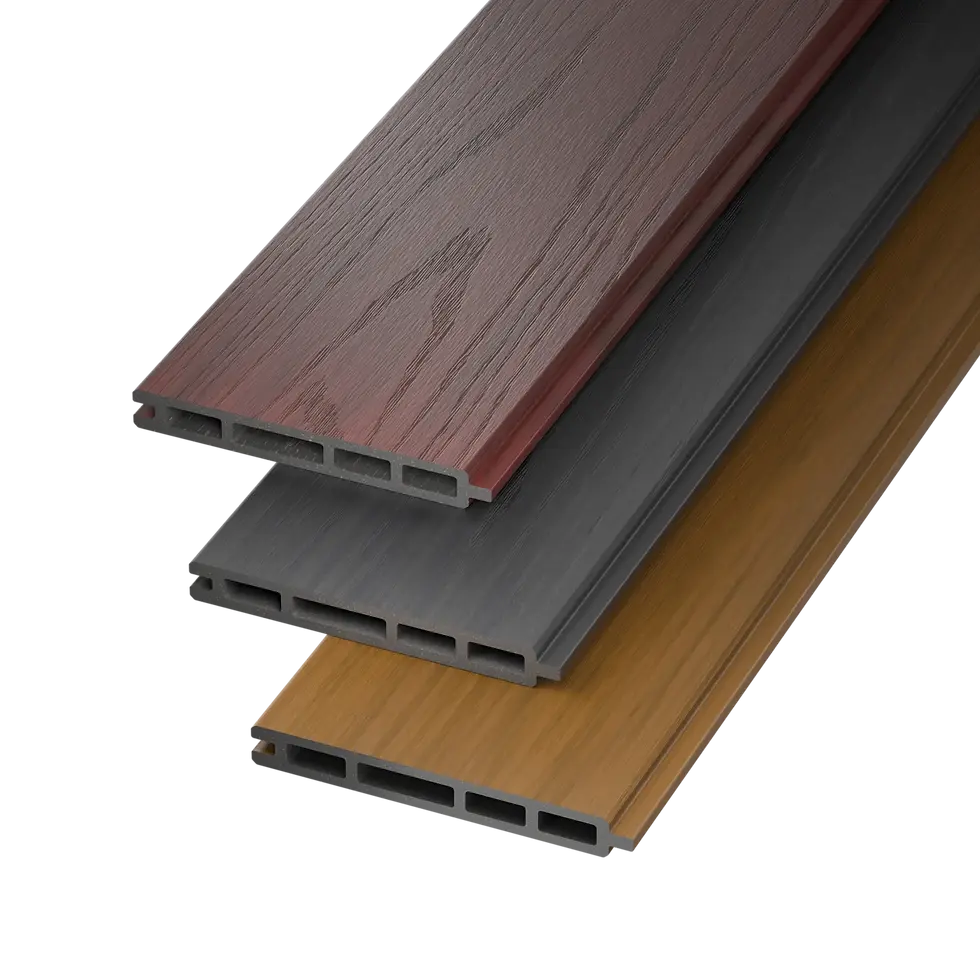
Composite Boards in Three Colors
Vertical composite boards offer a wood-look infill in Redwood, Teak and Charcoal.

Supporting Steel Posts
An independent In-Ground straight section uses two 98-inch steel posts. The six-foot Surface Mount configuration uses 74-inch welded-base-plate posts with separately supplied anchors.

Vertical Rails and Connections
The vertical set contains two 94-1/2-inch steel U rails, aluminum connectors, end caps, and screws. Rails hold the tops and bottoms of upright boards.
Components of Vertical Composite Fencing
Composite boards, steel posts and matching rails form a coordinated fence system.


Vertical Composite Fencing for Changing Landscapes
The vertical composite system accommodates slopes, stepped sections and angled layouts.
Sloping Ground
Upright composite boards and compatible fittings maintain a vertical pattern along sloping ground.
Stepped Sections
Vertical boards and matching rails create stepped fence sections as the ground changes elevation.
Angled Fence Runs
Side-mount U-channels and mounting wedges support angled connections between fence sections.
LINE Topper and Matching Gate Options
Vertical board systems include a seven-foot LINE-top configuration and coordinated gates.
The Seven-Foot LINE-Top Configuration
The Teak vertical LINE-top layout is nominally 8 ft W × 7 ft H. Composite boards sit below two LINE slats, supported by matching vertical rails and 114-inch In-Ground steel posts.
Coordinate the Boundary and Entry
Vertical composite gates use aluminum frames, upright board infill and In-Ground posts. The Teak vertical gate with a LINE crossbeam retains a six-foot leaf for a seven-foot fence connection.
Vertical Composite Fencing FAQs
Are Composite Vertical Fence Panels Complete Kits?
Four-board packs supply infill. Complete vertical configurations also include the steel posts, vertical rail set and matching hardware.
Should I Choose Horizontal or Vertical Boards?
Both directions are available. Vertical boards use steel U-rails and aluminum connectors; the horizontal system has aluminum rails with its own section dimensions.
How Much Care Does the System Need?
The WPC boards need cleaning but no routine painting, staining or sealing. Matching metal supports coordinate the frame around the upright boards.
Which Colors Are Available?
Redwood, Teak and Charcoal are the standard board colors. Private Black is the metal-component finish.