
How to Choose a Complete Modern Fence and Gate System for Your Backyard
Map your yard before you shop. A backyard usually contains two or three different fencing jobs in one perimeter. Full privacy along one line, airflow or a view along another, and access at one or more points. The right modern fence and gate system covers all of them with matched panels, posts, gate frames, and hardware, so you're specifying one system instead of stitching together suppliers. This guide walks the requirements-to-system workflow in five steps.
At a glance
Who this is for | What you'll get | What to avoid |
Homeowners planning a full backyard perimeter or a major section | A five-step requirements workflow plus a system completeness checklist | Buying panels first and treating the gate as an afterthought |
Homeowners working with an installer at design stage | A one-page spec you can hand to any dealer or contractor | Mixing components from unrelated suppliers and hoping the hardware bridges the gap |
What does a complete fence and gate system actually include?
A complete system covers seven component groups. Posts, rails, infill panels, a gate frame, hinges, a latch or lock, and fasteners, all engineered to the same dimensional logic. Modern Yard is a modular fence and gate system platform where every component, from the post to the lock, is designed to work together, which is what separates a system from a pile of compatible-looking parts.
A gate kit is not a complete fence and gate system. A gate kit typically includes the gate frame and basic hardware without matched posts, rails, or infill, which leaves the compatibility work to you. A complete system means the gate accepts the same infill as the fence, hangs on a post from the same platform, and closes on hardware designed for the frame.
Use this checklist against any system you evaluate.
Component | Included in a complete system? | What to verify |
Posts | Yes | Do they match the rail and infill dimensions? |
Top and bottom rails | Yes | Are both included, or only one? |
Infill panels | Yes | Are material options and sizes specified? |
Gate frame | Yes | Does it accept the same infill as the fence? |
Hinges | Yes | Are they specified for the frame, and how are they installed? |
Latch or lock | Ideally yes | Is the lock designed for the gate frame? |
Fasteners | Yes | Listed by the manufacturer, or left to you? |
How do you map privacy zones before choosing materials?
Walk the perimeter and label each line by what it needs to do. Lines facing a neighbor's windows or a street usually need full privacy. Lines along a garden, a pool area, or a view often work better with airflow and light passing through. Most yards end up with both kinds of line, and that's the case a single-supplier panel purchase handles worst.
For the open lines, an option like myAir fits the job as designed. myAir is an open, ventilated aluminum slat system that passes air and light, which suits pool surrounds, garden edges, and any line where you want definition without a solid wall. It isn't a full-privacy panel and shouldn't be specified where visual screening is the requirement.
One regional note on terminology. In California, where the phrase "good neighbor fence" is most commonly used, the term usually refers to a full-privacy fence that looks finished on both sides. Panel systems like myRedwood and myFireGuard present the same appearance on both faces, which is what that expectation describes. myAir sits outside that category. Its slat structure looks similar from either side, but it's an open design rather than the full-privacy construction the California term generally implies, so keep the two ideas separate when you talk to neighbors or an HOA.
How should access points drive gate planning?
Count the gates before you count the panels. Every place a person, a mower, or a trash bin crosses the fence line needs an opening, and retrofitting a gate into a finished run costs far more than planning it. Most backyards land on one or two gates. A side-yard passage gate and sometimes a wider access point for equipment.
Decide swing direction at the planning stage, based on grade, obstructions, and which way traffic naturally flows. Hardware usually forces that decision early because most locks fit only one swing direction. Modern Yard's myLock-Combination removes that constraint with Universal Fit, meaning the same lock works on left-swing and right-swing gates without extra parts, so a late change in swing direction doesn't strand your hardware.
The lock decision belongs in planning, not at the end. The myLock-Combination is a 304 stainless steel mechanical lock with sequential code entry, 665,000 combinations, and no batteries, built for long-term outdoor use and covered by a 25-year limited warranty. Because Modern Yard gate frames come pre-drilled for it, choosing the lock inside the system means no on-site drilling when installation day arrives.
Which layout and site factors change what you order?
Measure the lines, then note everything that isn't flat and straight. Slopes, corners, and grade changes each affect the component list, and they're the reason two yards with the same total footage can need different orders.
Slopes decide whether runs step or rack, and either approach changes post placement. Corners add posts, and a system built on a universal post platform handles them without special parts. The Modern Yard Universal Post System supports multiple fence types within a single post, so a line post, corner post, and gate post come from the same platform, which keeps the order simple even when the layout isn't.
Transitions matter too. Where a full-privacy line meets an open slat line, or where fence height changes, the connection details determine whether the result looks planned or patched. A modular connector system designed for flat, sloped, and corner conditions covers those transitions inside the system rather than with improvised brackets.
How do you compare material options inside one system?
Compare materials by line, not for the whole yard at once. The system approach makes this practical because composite, steel, and aluminum infill all run on the same post platform, so mixing materials by zone doesn't mean mixing suppliers.
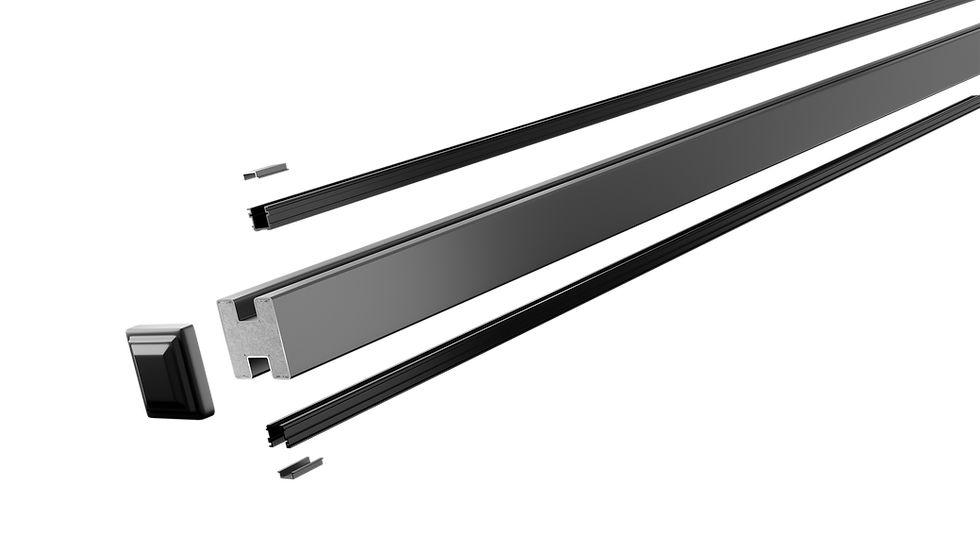
Composite panels like myRedwood deliver a wood appearance with lower upkeep than wood itself. Steel panels carry the structural cases. Modern Yard's steel system is wind load rated up to 130 MPH and uses the TriShield triple-layer protection system for long-term corrosion resistance, and the fire-resistant FireGuard series is tested to ASTM E84 Class A and listed on the California Fire Safe Council Vendor List, which matters if your area carries wildfire requirements. Aluminum slats carry the open, ventilated lines.
Whatever the mix, maintenance expectations should rest on the warranty rather than on adjectives. The system is backed by a 25-year limited warranty, which is the concrete answer to how long the manufacturer stands behind it.
Use case | What matters most | Why a system approach fits |
Full-privacy property line | Solid panels, consistent look on both faces | Matched panels, posts, and gate in one system |
Pool or garden line needing airflow | Open, ventilated structure with light passthrough | myAir aluminum slats on the same post platform |
Fire-prone or WUI area | Fire-resistant, documented materials | FireGuard series, ASTM E84 Class A, CFSC listed |
Frequent-access side gate | Reliable hardware, no swing-direction lock-in | Pre-drilled frame, Universal Fit lock |
How do you turn requirements into an order-ready spec?
Condense the mapping work onto one page. List each fence line with its length, its job, its material choice, and its height. List each gate with its width, swing direction, and hardware. Note the slopes, corners, and transitions. That single sheet is a specification any dealer or installer can price accurately, and it protects you from the quote that quietly substitutes components.
Verify the components exist as specified before you commit. The products catalog lists the posts, rails, gate frames, lock, and accessories, so every line on your sheet can be matched to a real SKU. The installation guides show how each piece goes in, which is worth reviewing even if a contractor does the work, because it tells you what a correct installation looks like.
Seeing the system installed helps calibrate the design choices. The inspiration gallery shows completed projects, which is a faster way to judge how a material reads in a real yard than any sample swatch.
Take the sheet to an authorized dealer, get the quote against your spec, and you've done the choosing before anyone tries to do it for you.
FAQ
What's included in a complete fence and gate system?
Seven component groups. Posts, rails, infill panels, a gate frame, hinges, a latch or lock, and fasteners, all engineered to the same dimensional logic. If any group is missing or comes from an unrelated supplier, you're assembling components rather than buying a system.
Is a gate kit the same as a fence and gate system?
No. A gate kit typically includes only the gate frame and basic hardware, without matched posts, rails, or infill panels. A complete system means the gate accepts the same infill as the fence and hangs on posts from the same platform, so the compatibility work is done by the manufacturer instead of on-site.
Can one fence system mix privacy panels and open slats?
Yes, when the system is built on a shared post platform. Modern Yard's Universal Post System supports composite, steel, and aluminum infill within the same framework, so a full-privacy line and an open ventilated line can run on the same posts with a consistent look.
What is a good neighbor fence?
It's a term used most commonly in California for a full-privacy fence that looks finished on both sides. Systems with identical faces, like myRedwood composite and myFireGuard steel panels, match that expectation. Open slat systems like myAir look similar from both sides but are ventilated rather than full-privacy, so they sit outside what the term usually means.
How many gates does a typical backyard need?
Most backyards need one or two. A side-yard passage gate for people, and often a wider opening for mowers, bins, or equipment. Count the crossings during planning, because adding a gate to a finished run costs far more than including it in the original layout.
Does the Modern Yard lock work on left-swing and right-swing gates?
Yes. The myLock-Combination has Universal Fit, which means it installs on either swing direction without extra parts or a different version. It's a battery-free 304 stainless steel lock with sequential code entry and 665,000 combinations, covered by a 25-year limited warranty.
What warranty covers the system?
Modern Yard backs the system with a 25-year limited warranty. The warranty documents and test reports are published on the warranty information page at mymodernyard.com, so you can read the actual terms before you buy.