.png)
Vinyl Fence Alternatives: Better-Looking Composite Options
- Jul 7
- 4 min read
Vinyl solved one problem: it stopped you from staining a fence every year. But it created another one. It looks like plastic, it can crack in a hard freeze, and it flexes in strong wind. So when people go looking for vinyl fence alternatives, they are usually not trying to escape the low maintenance. They are trying to keep the low maintenance and finally get a fence that looks good and stands firm.
That is the honest starting point, and it changes which alternatives are actually worth your time.

Why people leave vinyl in the first place
It helps to name the exact thing you are trying to fix, because vinyl gets a few things right. It does not rot. It does not need paint. A garden hose keeps it clean. If those were the only criteria, there would be no reason to shop around.
The reasons people do shop around tend to be:
The look. Vinyl reads as glossy, smooth, and manufactured. In bright sun it is unmistakably plastic, and solid-color panels never pass for real timber.
Cold-weather brittleness. Vinyl can grow rigid and crack under impact in deep cold.
Wind flex. Its light weight lets panels bow and work loose in high gusts.
Repairs that do not match. A cracked panel means swapping the whole section and hoping the color still lines up years later.
A good alternative should keep vinyl's easy upkeep while fixing the look and the structure. That narrows the field fast.
The main vinyl fence alternatives, compared
Here are the options homeowners actually weigh against vinyl, and the trade-off each one carries.
Option
Best for
Trade-off
Natural wood
Authentic cedar or redwood grain
Staining, sealing, warping, and rot at the soil line
Aluminum
Clean, modern, low-maintenance lines
Open picket look; little privacy or warmth
Chain link
Lowest cost, security barriers
No privacy, no curb appeal
Composite infill on steel posts
Wood look plus real durability and low upkeep
Higher up-front investment than plain vinyl
Wood gives you the warmth vinyl lacks but hands back every maintenance chore. Aluminum and chain link are durable and low-fuss but give up privacy and the cozy timber feel. The composite-on-steel route is the one that keeps vinyl's low upkeep, adds the wood look, and puts real structure underneath.
The alternative that fixes both the look and the structure
This is where Modern Yard fits the conversation. It is not a single panel product. It is a modular metal-post fence and gate system, which means the part you see and the part that holds everything up are two different, purpose-built pieces.
myPost is the universal steel post platform. It comes in myPost-74in, myPost-98in, and myPost-114in heights, so you can size a privacy run, a standard yard fence, or a taller screen.
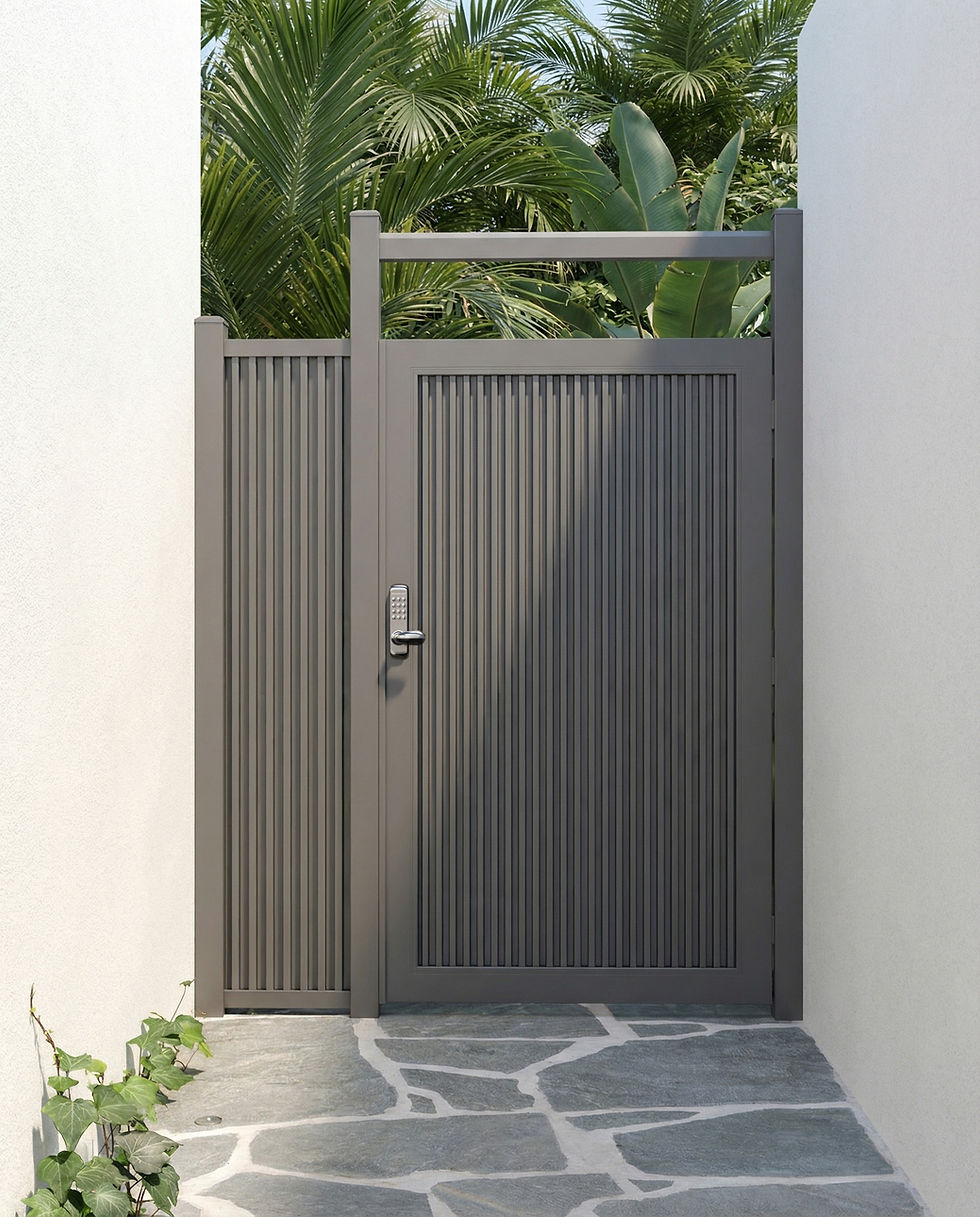
myRedwood is the wood-look composite infill. This is the piece that gives you cedar and redwood warmth instead of a plastic sheen.
myFireGuard is steel infill with an ASTM E84 Class A fire rating, for properties near open brush.
Aluminum and wood infill options round out the system.
The difference from vinyl is structural. Vinyl's strength is only whatever the panel itself provides. Here the strength lives in the steel post platform, and the infill you choose handles the look. That is what lets a fence look like wood and behave like engineered hardware at the same time.
Why the construction holds up where vinyl gives out

Each Modern Yard piece is built on a high-strength steel core, then layered with galvanized zinc coating, an epoxy primer, and an electrostatic powder-coat finish, with foam-sealed ends to keep moisture from creeping in. That stack is why the system is tested to 120 MPH wind resistance and carries a 25-year limited warranty. Vinyl does not compete in either of those categories, and it has no place at all in the fire conversation, because it is plastic.
Both faces of the fence are finished, too, so it looks the same from your yard and your neighbor's. In California that satisfies the "good neighbor" fence standard without paying for two pretty sides.
Modern Yard also markets the system as roughly 2.5 times more durable than comparable products and about 50 percent easier to install because it is modular. Treat those as the brand's own claims. The 120 MPH rating, the Class A fire option, and the 25-year warranty are the verified facts to plan around.
Matching an alternative to your priorities
Pick your alternative by what actually pushed you off vinyl.
If you left because of wind or cold, lean on the steel-post platform and its 120 MPH rating rather than any solid panel.
If fire safety is on your mind, put myFireGuard steel infill on the side facing open brush and run myRedwood everywhere else, all on the same posts.
If repairs frustrated you, remember that a standardized modular system lets you address one infill section while the posts stay put.
Confirm local height limits and HOA rules, then find a qualified contractor through the Modern Yard dealer locator.
Common questions about switching from vinyl
Is composite really a better fence than vinyl?
For look, wind, and fire, yes. Composite infill on steel posts gives you a genuine wood appearance, 120 MPH wind resistance, and a fire-safe option, while vinyl is lighter, reads as plastic, and stays out of the fire-rating conversation. On day-to-day maintenance the two are about even, since neither needs staining.
Will a composite fence stay low-maintenance like vinyl?
Yes. A periodic rinse with a garden hose handles most dirt, the same as vinyl. You keep the no-stain, no-seal routine that made you buy vinyl in the first place, and you add the wood look and steel structure on top.
Can I get privacy without the plastic look?
That is the point of pairing myRedwood infill with a taller myPost height. You get a solid, private, wood-look run without the glossy plastic surface vinyl gives you.
Ready to see the difference
If vinyl left you wanting the wood look and more backbone, compare Modern Yard's modular system against it on the things that matter, then use the dealer locator to find a qualified contractor and request a quote.