
Can Composite Fence Boards Be Installed Horizontally and Vertically? What Changes Between the Two Layouts
The short answer is yes, but the installation requirements aren't the same for both directions, and not all composite board systems handle both equally well. Horizontal and vertical layouts create different structural demands on the board, the fastener, and the rail system. The main variable is thermal expansion: composite boards expand and contract with temperature changes, and how that movement is managed differs between horizontal and vertical installation. This guide covers what changes between the two layouts, what to verify in the board system you're specifying, and how Modern Yard's myRedwood system handles both orientations.
At a glance
Composite fence boards can be installed horizontally or vertically, but each orientation requires a different rail system and handles thermal expansion differently. Horizontal boards expand along their length, which runs parallel to the fence line. Vertical boards expand along their length, which runs perpendicular to the fence line. Modern Yard's myRedwood composite fence system supports both orientations with separate matched rail sets: the Horizontal Rail Set for horizontal layouts and the Vertical Rail Set for vertical layouts. Installation guides for both are available at the Modern Yard installation guides page.
What actually changes between horizontal and vertical installation
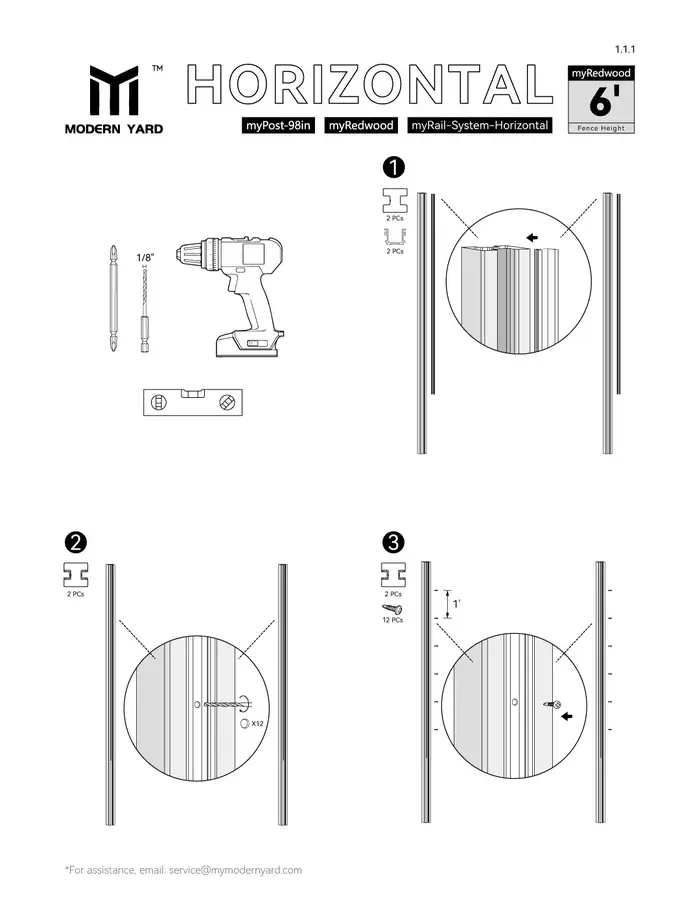
The board itself is the same in both orientations. What changes is how it's supported, how it's fastened, and how thermal movement is managed.
Rail system. Horizontal installation uses rails that run vertically, perpendicular to the boards, creating the horizontal channels the boards slot into. Vertical installation uses rails that run horizontally, creating the vertical channels. These aren't interchangeable. A rail system designed for horizontal boards positions the support at the wrong interval for vertical boards, which affects both structural performance and spacing consistency.
Board span and support interval. In horizontal installation, each board spans the full width between posts, supported at the post locations. In vertical installation, each board spans the full height between the top and bottom rails, with intermediate rails providing support at mid-height for taller fence configurations. The support interval matters because composite boards have a maximum unsupported span beyond which deflection becomes visible.
Fastener placement. The fastener position relative to the board end affects how thermal movement is accommodated. In horizontal installation, fasteners at the post typically allow a small gap at the board end for expansion. In vertical installation, fasteners at the rail allow movement along the board's length, which is vertical. The gap allowance and fastener method differ between the two configurations.
Visual logic. Horizontal boards emphasize the fence line and work with contemporary architectural aesthetics where horizontal elements are dominant. Vertical boards emphasize height and read as more traditional, similar to board-on-board wood fences. Both are valid design choices, but the decision affects which rail set is needed and how the installation sequence proceeds.
How thermal expansion affects each layout
Composite boards expand and contract with temperature. In most residential fence applications, the temperature range across seasons produces meaningful dimensional change along the length of the board, enough to cause buckling if the expansion isn't accommodated, or visible gaps if the contraction isn't managed.
In horizontal installation, the board length runs parallel to the fence line. Thermal expansion pushes the board ends toward the posts. A gap at each board end, or a fastener method that allows the board to slide slightly, accommodates this movement without buckling. If the board is fastened rigidly at both ends with no expansion allowance, temperature increases can cause the board to bow outward.
In vertical installation, the board length runs from the bottom rail to the top rail. Thermal expansion pushes the board ends toward the rails. The rail connection method needs to accommodate vertical movement. A board that's fastened too rigidly at both the top and bottom rail can bow or lift if expansion isn't managed.
The tongue-and-groove profile in myRedwood boards manages this differently than a flat board system. In a tongue-and-groove system, adjacent boards interlock. The groove absorbs some of the lateral pressure from expansion rather than transmitting it entirely to the fastener. This reduces the tendency for boards to push apart or buckle at the face, and it maintains the seamless surface appearance even as the boards move with temperature changes.
Worth knowing. Composite boards with full-perimeter UV protection, including on the board ends, expand and contract more uniformly than boards where only the face is coated. A board that's UV-protected on all four sides ages and moves more consistently than one where the ends and edges are exposed to differential weathering.
What to verify before choosing a layout
Does the board system explicitly support both orientations? Not all composite fence board products are rated or designed for both horizontal and vertical use. Some are designed specifically for one orientation, and installing them in the other can affect structural performance, warranty coverage, or the visual result. Verify this in the product documentation before specifying.
Is there a separate rail set for each orientation? A system that supports both orientations should have matched rail sets for each. A single rail set used for both directions is a signal that the system wasn't fully engineered for dual-orientation use.
What is the maximum unsupported span for each orientation? Composite boards have a maximum span beyond which deflection is visible. This applies differently in horizontal and vertical configurations. Check the technical specifications for your specific board to confirm the support interval is achievable with the post spacing you're planning.
How does the system handle thermal expansion at the fastener points? Look for explicit guidance on gap allowance at board ends in horizontal installation, and at rail connections in vertical installation. A system that doesn't address this leaves the installer to improvise, which affects long-term performance.
Does the gate frame accept both orientations? If the gate needs to match the fence, confirm that the gate frame can accept the same board in the same orientation. A gate frame designed only for one infill orientation creates a visual break when the fence uses the other.
How Modern Yard's myRedwood handles both orientations

Modern Yard's myRedwood board is designed to work in both horizontal and vertical configurations, with a separate matched rail set for each orientation.
Horizontal layout with the Horizontal Rail Set. The Horizontal Rail Set positions boards in horizontal runs with consistent spacing set by the rail system rather than by manual measurement. The tongue-and-groove profile between boards manages lateral expansion pressure and maintains the seamless surface appearance. The rail attaches to the Modern Yard slotted steel post and sets the board height and spacing across the full fence section.
Vertical layout with the Vertical Rail Set. The Vertical Rail Set positions boards in vertical runs with consistent spacing. The same tongue-and-groove profile applies, with the interlocking geometry now running vertically between adjacent boards. The rail set accommodates the different support requirements of vertical installation, with horizontal rails at the top, bottom, and mid-height positions for taller fence sections.
Same board, same post, different rail. The myRedwood board itself is identical in both configurations. The Modern Yard slotted steel post is also the same. The only component that changes between horizontal and vertical installation is the rail set. This simplifies material planning for projects that use both orientations in different sections of the same yard.
Gate frame compatibility. The myRedwood board is compatible with Modern Yard gate frames in both horizontal and vertical orientations, so the gate can match the fence regardless of which layout is used. Gate frames are available in sizes that work with both single and double-door configurations.
Technical drawings for both the horizontal and vertical configurations, including profile and exploded views, are available at the Modern Yard technical drawings page. Separate installation guides cover each orientation in detail.
Confirm the rail set before you order
The board is the same for both orientations. The rail set is not. Before ordering materials for a horizontal or vertical composite fence, confirm which rail set is required for the layout, verify the board's thermal expansion handling in that orientation, and check that the gate frame accepts the board in the same direction as the fence. For myRedwood, the Modern Yard product catalog lists both rail sets with their compatible configurations, and installation guides for each orientation are at the installation guides page.