.png)
How to Get an Accurate Fence Material Estimate Before You Call a Contractor
- Jun 3
- 4 min read
Most fence quotes arrive as a single number. Materials, labor, markup, and margin are combined into a lump sum that's difficult to verify, compare, or challenge. Homeowners who want to understand what they're paying for often can't tell whether a quote is high because the material specification is premium or because the markup is.
The clearest path to a fence estimate you can actually evaluate is separating the material cost from the labor cost before anyone picks up a shovel. This guide covers why traditional fence quotes are hard to verify, what a more transparent process looks like, and how Modern Yard's Quick Quote system approaches material estimation.
At a glance
Modern Yard offers a two-path Quick Quote process: upload a layout sketch to receive a materials list and pricing, or schedule a contractor visit to measure the yard and create the sketch first. A downloadable fence planning sheet and example layout are available at the Modern Yard Quick Quote page. Materials are purchased through a nearby authorized dealer. The process separates material estimation from installation labor, giving homeowners a clearer view of what the project actually requires before committing.
Why traditional contractor fence quotes are hard to verify
The opacity in a traditional fence quote has structural causes, not just pricing ones.
Materials come from multiple suppliers with variable pricing.
A contractor sourcing posts, boards, rails, gate hardware, and fasteners from different suppliers is working with a materials cost that shifts with availability and supplier relationships. The homeowner can't independently price-check the components because the component list isn't provided in detail.
Labor and materials are bundled.
A quote of "$X installed" doesn't tell you whether you're paying $Y for materials and $Z for labor, or some other split. For a homeowner trying to compare quotes, there's no way to evaluate whether one contractor is more efficient or whether one is using better materials.
SKU complexity makes line-item verification difficult.
A traditional fence project might require posts in two lengths, three types of rail hardware, custom-cut boards, gate hardware from a separate source, and fasteners sized to the specific post and board combination. Reconstructing that list from a lump-sum quote requires technical knowledge most homeowners don't have.
The result is that most homeowners evaluate fence quotes by comparing total numbers, without the ability to assess whether the underlying material specification and quantity are actually equivalent between quotes.
What a cleaner estimate process looks like
Materials list separate from labor.
An estimate that provides a line-item material list, showing specific SKUs, quantities, and unit pricing, lets the homeowner verify the material cost independently. Labor is a separate variable that depends on the installation complexity and the contractor.
A planning tool the homeowner can use before calling anyone.
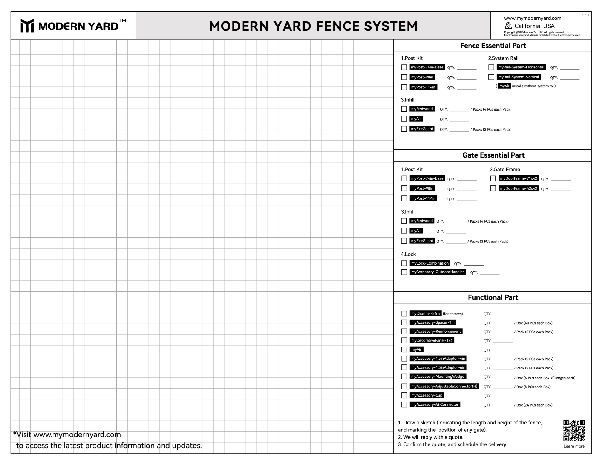
A downloadable layout planning sheet with standard dimensions and a fill-in format lets the homeowner capture fence line length, gate locations, and corner count before the first contractor conversation. Having those numbers in advance gives context for evaluating what a contractor quotes.
Standardized SKUs that translate to predictable quantities.
A fence system with a single post platform, matched rail sets, and known board dimensions produces a material list that's calculable from a layout sketch. Post count drives everything else. The math is reproducible, which means a second estimate should arrive at the same material quantities for the same layout.
Purchase through a local dealer with visible pricing.
When material purchase happens through an authorized dealer with accessible pricing, the homeowner can verify the material cost component of any quote that includes the same system.
How Modern Yard's Quick Quote process works
Modern Yard provides two paths to a material estimate at the Quick Quote page, depending on where the homeowner is in the planning process.
Path 1: Upload a sketch for a material estimate.
For homeowners who already have a layout, uploading the sketch generates a materials list and pricing. Materials are purchased through a nearby authorized dealer. This path separates the material estimation from the contractor relationship, letting the homeowner understand the material cost before labor is added.
Path 2: Schedule a contractor visit.
For homeowners who don't have a layout yet, Modern Yard connects them with a local contractor who can measure the yard and create a layout sketch. The sketch then feeds into the material estimation process.
Planning tools available before either path: A fence planning sheet is available for download at the Quick Quote page, with an example completed layout for reference. Homeowners can use these to capture their own measurements before submitting, or to check a contractor's layout against their own walkthrough.
Before you call anyone. Download the Modern Yard planning sheet from the Quick Quote page, walk your fence line with a tape measure, and fill in the basic dimensions. Having your own layout sketch before the first contractor conversation gives you a reference point for evaluating what's quoted back to you.
Why a standardized system makes estimates more accurate
The accuracy of a material estimate depends on how predictable the component count is from a given layout. A fragmented system, where posts, boards, rails, and hardware come from different sources with variable dimensions, introduces estimation uncertainty at every step. A standardized system with fixed component relationships produces a more reliable quantity calculation.
One post platform drives the whole count.
In the Modern Yard system, post spacing determines the quantity of every other component. Rail sets are matched to post spacing. Board quantities follow from the fence height and post count. Gate frames are discrete SKUs. There's no variable that requires a judgment call to estimate.
Fixed rail-to-infill compatibility eliminates substitution uncertainty.
When the rail system is specified for a particular infill, the material list has no "or equivalent" variables. The same specification produces the same material list every time.
Technical drawings support accurate planning.
Dimensioned drawings for each fence system are available at the Modern Yard technical drawings page, covering component dimensions and assembly details. Contractors and homeowners can verify component counts against actual dimensions before ordering.
Start with the material list, then evaluate the labor
A fence project estimate you can verify starts with a material list that's independent of the labor quote. Getting that list before contractor conversations begin changes the evaluation dynamic: instead of comparing total numbers, you're comparing the labor component applied to a known material cost. The Modern Yard Quick Quote page provides the planning tools and estimation path to reach that starting point before any contractor commitment is made.