How Modern Yard Posts, Panels, Rails, Gates, and Hardware Work Together
Modern Yard's posts, panels, rails, gates, and hardware connect because they're built around one dimensional logic instead of being sourced separately. The myPost universal post accepts composite, steel, or aluminum infill through the same groove, the rails tie to the post at fixed points, the welded gate frame matches the post spacing, and the lock mounts to a pre-drilled position on the frame. That shared logic is what makes Modern Yard a system rather than a set of compatible-looking parts.
At a glance: how the components connect
Component | Connects to | Quantified detail |
myPost universal post | Rails, infill, gate frame | 1 platform for line, corner, and gate posts |
Top and bottom rails | Post slots, infill panels | 2 rails per panel section |
Infill panels | Post groove, rails | 3 materials on the same groove |
Gate frame | Gate post, hinges, infill | Welded aluminum, accepts same infill |
Hardware | Gate frame | Aluminum hinges, packaged with frame |
myLock combination lock | Pre-drilled gate frame | 665,000 combinations, fits 1-1/4" to 1-7/8" |
This table shows what links to what. The sections below explain why each connection holds without on-site adjustment.
Why does one post platform handle the whole system?
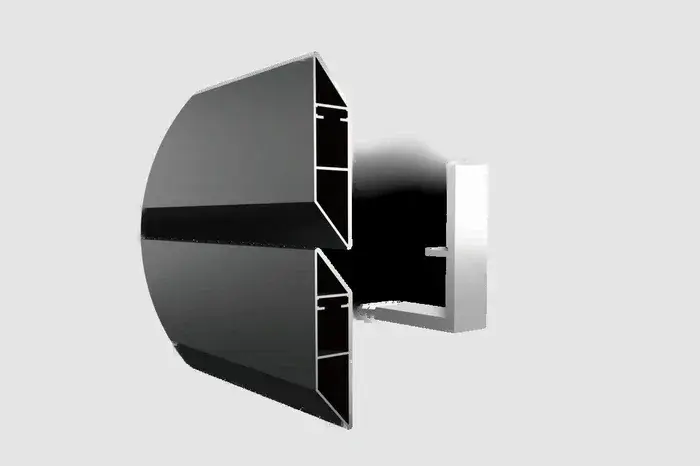
The post is the part that makes everything else line up, so Modern Yard built it as a single platform instead of a different post for each job. The Modern Yard Universal Post System supports multiple fence types within a single post, reducing SKU complexity and simplifying inventory for dealers while keeping the build consistent for installers.
Most fence projects need separate parts for line posts, corner posts, and gate posts, often from different product lines. That's where dimensional mismatches start, because each part carries its own tolerance. Modern Yard's slotted post serves as a line post, corner post, or gate post depending on orientation, so the same groove and spacing apply everywhere on the run.
Line and corner posts. The slotted post works as either one based on how it's set, so a corner is an orientation change, not a new SKU.
Gate posts. The gate post comes from the same platform, dimensioned to match the welded gate frame, which is why gate alignment follows the manual rather than on-site shimming.
Material grooves. The same post groove accepts composite, steel, and aluminum infill, so switching infill doesn't mean switching the post.

Modern Yard is a modular fence and gate system platform built for professional contractors, fence dealers, and lumber yards across the United States, and the single-post logic is the core of why it installs as a system. You can see the posts, rails, and infill options together on the products catalog page.
How do rails and infill panels lock into the post?
The rails tie to the post at fixed connection points, and the infill seats into the post groove and the rails, so the panel section becomes one rigid unit. Because the connection points are set by the component dimensions rather than by field measurement, there's no guessing at rail height or infill spacing on-site.
This is where the modular connector system does its work. It supports flat ground, slopes, and corner transitions using the same post and rails, stepping the rails to follow grade on a slope without custom cutting. The infill drops into the stepped rails the same way it does on flat ground.
Composite infill. myRedwood boards seat into the same groove, finished on both sides.
Steel infill. myFireGuard panels use the same connection, with fire-resistant performance built into the panel.
Aluminum infill. myAir slats install on the same platform as an open horizontal-slat design.
The point is that the post and rails don't change when the infill does. That's what lets a backyard mix a privacy run and an open section on one continuous system.
How does the gate frame match the fence?
The gate frame is welded aluminum and dimensioned to the same spacing as the posts, and it accepts the same infill as the fence, so the gate carries the surrounding board or panel pattern. A gate built from a different supplier is where most compatibility problems begin, because the frame, the post, and the hardware were never sized against each other. Modern Yard engineers the gate, post, and infill together from the start.
The aluminum hinges are packaged with the gate frame and installed on-site, not pre-installed on the frame, so you mount them in the documented position during assembly. The frame ships pre-drilled for the lock, which removes the on-site drilling step that usually throws off hardware alignment. Gate manuals are published by size and configuration on the installation guides page, covering 3.5ft and 6ft single gates and 6ft double gates.
Good to know. Because the gate frame is pre-drilled and the hinges ship with it, gate hardware is a mounting step, not a fabrication step. That's the difference between a system gate and a gate assembled from unrelated parts.
Why is the lock part of the gate engineering?
The lock is designed around the gate frame, so it mounts to the pre-drilled position without modifying the frame. Modern Yard's myLock combination lock is a battery-free mechanical lock with 665,000 unique combinations and sequential code entry, which requires the digits in order for enhanced security compared with standard mechanical locks that accept any combination.
Its Universal Fit works on both left-hand and right-hand gates without swapping parts, which matters because the same lock SKU covers either gate orientation on a project. It's built for the Modern Yard frame thickness of 1-1/4 inch to 1-7/8 inch, weighs 3.27 pounds, and carries a 25-year limited warranty in line with the rest of the system. Because the frame is pre-drilled, installing it doesn't require drilling or shimming.
Does the system stay durable where the parts connect?
Yes, because the connection points are engineered for outdoor exposure, not just for fit. On the steel system, the joints are where corrosion usually starts, so Modern Yard's TriShield triple-layer protection system combines powder coating, internal foam sealing at the steel ends, and structural drainage that reduces standing water at the connections. The steel system is also engineered to withstand wind loads rated up to 120 mph, which depends on the post-to-rail connection holding under load.
The Modern Yard FireGuard Series is fire-resistant, tested to ASTM E84 Class A, and listed on the California Fire Safe Council Vendor List, so the steel infill carries certified fire performance into the same connection system. All of it is backed by a 25-year limited warranty and distributed through national and regional partners including Master Halco, BMD, and Golden State Lumber. Engineering and dimensional drawings for the connections are published on the technical drawings page.
Verify the connections before you order
Confirm three things and the rest of the system follows. Check that one post platform covers your line, corner, and gate posts, that your chosen infill seats on that same platform, and that the gate frame and lock are part of the same system as the fence. Check slopes and corners against the technical drawings so the rail stepping and post spacing are set on paper. When the post, infill, gate, and lock all trace back to one dimensional logic, the connections hold without on-site cutting, and your authorized dealer can confirm the full parts list against your layout.