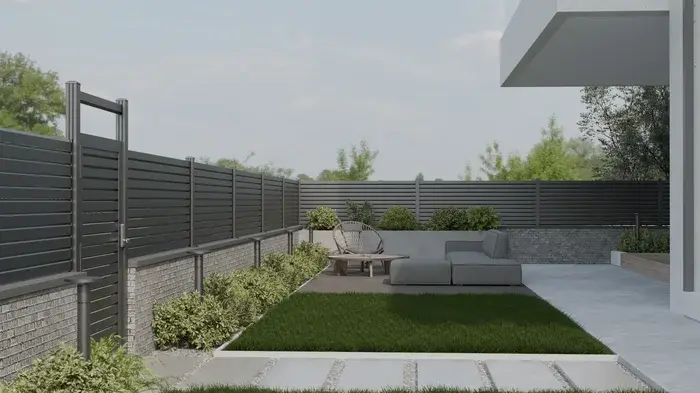
.png)
How to Handle a Sloped Yard with a Modern Fence System: Stepped Installation and Panel Customization Explained
- 3 days ago
- 5 min read
Sloped yards are one of the most common reasons fence projects get more complicated than expected. The fence needs to follow the perimeter, but the ground doesn't cooperate with standard panel heights and post spacing. The question isn't whether a modern fence system can handle a slope. Most can, with the right installation approach.
The question is which method the system supports, and whether the components can be adjusted without losing the clean look that makes a modern fence worth building. This guide covers the two standard approaches for sloped ground, how Modern Yard's systems handle each, and what to plan before installation starts.
At a glance
The standard approach for installing a fence on sloped ground is stepped installation: each fence section runs level, with the post height adjusted to follow the grade change between sections. For stepped installation, panels or boards that land above grade at the bottom of a section can be cut to fit.
Modern Yard's FireGuard steel panels can be cut to custom widths for site-specific configurations. The myAir aluminum slat system offers additional flexibility because each slat installs independently. Technical drawings for all systems are available at the Modern Yard technical drawings page.
The two ways fence systems handle sloped ground
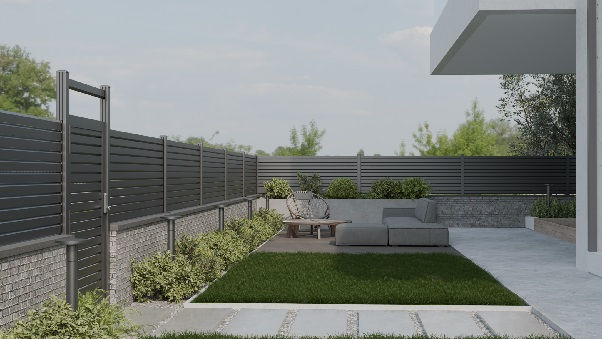
Understanding the two methods upfront avoids a lot of planning confusion.
Stepped installation.
Each fence section runs level, like a staircase. The posts at each step change height to follow the grade. The bottom of each fence panel or board section sits at a fixed distance from the ground at the high end of that section, and the gap between the fence bottom and the grade increases toward the lower end of the section. That gap can be left open or filled with a separate gravel board or trim piece. This is the most common method for modern fence systems because it keeps the fence panels level and the lines clean.
Raked installation.
The fence follows the slope of the ground continuously, with the fence line running at the same angle as the grade. This requires either custom-fabricated panels at a specific angle or a system designed with adjustable components that allow the fence face to tilt. Raked installation is more common with traditional board-on-board wood fences where individual boards can be placed at any angle.
Most modern panel-based systems use stepped installation.
Panel systems with fixed geometry, including composite boards and steel panels, are designed to run level. The stepped approach maintains the visual precision of the panel geometry while adapting to grade changes through post height variation and panel trimming.
Why stepped installation works with modular systems
Stepped installation is well-suited to modular fence systems for a straightforward reason: the components are designed to run level, and the grade adaptation happens at the posts and at the bottom edge of the panels, not in the panel geometry itself.
Post height adjustment.
In a stepped layout, each post is set at the height needed to keep the top of the fence consistent while the bottom steps down with the grade. The Modern Yard slotted steel post is available in three sizes covering standard fence heights, and post length can be adjusted during installation to account for grade changes at each step location.
Panel trimming at the bottom.
When a stepped section creates a gap between the fence bottom and the grade that's larger than desired, the bottom edge of the panel or board can be trimmed to reduce the gap while keeping the fence top level. According to Modern Yard's product documentation, FireGuard panels can be cut to size to accommodate custom fence widths or site-specific layouts, which applies directly to bottom-edge trimming for stepped installations. Composite boards can similarly be trimmed at the bottom of a stepped section.
The result is a fence that reads as level and consistent from a viewing distance, with the grade change absorbed by the stepped post heights rather than visible in the panel geometry.

Which Modern Yard system handles slopes most flexibly
The three systems differ in how much field adjustment is possible during a stepped installation.
myAir aluminum slat system.
The most flexible option for sloped ground. Because each slat installs independently into the post slot, the bottom of the fence can be adjusted slat by slat to follow the grade more closely than a panel system allows. The tap-in wedge spacing connectors maintain consistent spacing between slats regardless of the bottom edge position. For a sloped yard where minimizing the gap between fence and grade is a priority, the slat-by-slat installation logic of the myAir system offers more control than panel-based alternatives.
myRedwood composite board system.
Individual boards install horizontally into a rail set, and the bottom board can be positioned to sit close to grade. On a sloped section, the bottom board position adjusts as part of the stepped layout. Boards can be trimmed at the bottom edge if needed. The tongue-and-groove profile means the boards above the trimmed one still seat correctly.
myFireGuard steel panel system.
The wide-panel format is the most rigid of the three in terms of field adjustment, but panels can be cut to custom widths for site-specific layouts. For stepped installations with irregular section widths at transition points, panels can be trimmed to fit the available space. FireGuard is vertical-only by design, which keeps the panel geometry straightforward for stepped layouts.
Worth planning in advance.
Stepped installation works best when the step locations are planned to align with post positions. Walking the perimeter before installation and marking where grade changes are significant enough to require a step, typically where the grade drops more than 4-6 inches over a standard post span, makes the layout cleaner and reduces field adjustment.
What to plan before installing on a slope
Map the grade changes across the full perimeter.
Walk the fence line and identify where significant grade transitions occur. Mark the approximate step locations before ordering materials. Step locations that fall mid-panel are harder to handle than steps that align with post positions.
Determine step frequency.
More frequent steps mean smaller height differences at each step and smaller gaps at the bottom of each section. Fewer steps mean larger height differences and more trimming at transition points. For modern fence systems where clean lines matter, more frequent steps with smaller gaps generally produce a better visual result than fewer steps with larger gaps.
Calculate post lengths for each step.
Post height at each step location needs to account for in-ground depth, the height difference from the previous step, and the desired above-grade fence height. Having these numbers before ordering avoids the most common material shortage on sloped projects.
Confirm which infill can be trimmed on-site.
FireGuard panels and composite boards can both be trimmed. Verify the trimming requirements for the specific system you're using and confirm that cut edges will be clean and consistent with the panel profile before the project starts.
Check technical drawings for your system.
Modern Yard publishes technical drawings for each fence system, including profile and exploded views that show component dimensions and assembly details. For sloped projects, knowing the exact post slot dimensions and panel height tolerances before installation reduces field uncertainty.
Plan the grade before you plan the fence
A sloped yard isn't an obstacle to a clean modern fence. It's a planning variable. Stepped installation handles grade changes within any of the Modern Yard systems, and the component-level flexibility, particularly the independent slat installation of myAir and the cuttable panels of FireGuard, gives installers the adjustment range they need. The Modern Yard installation guides cover the full installation sequence for each system, and technical drawings are available for dimensional reference before the project starts.