
Beyond Vinyl: What to Look for in a Modern Low-Maintenance Privacy Fence
Updated: Aug 19
Vinyl privacy fences solved one problem well: maintenance. No painting, no staining, no rot. The trade-off was design range. Most vinyl fence products share the same visual vocabulary, white or tan panels, routed pickets, basic post caps, that hasn't changed significantly in decades. For homeowners who want low maintenance but also want a fence that fits a contemporary backyard rather than a 1990s subdivision, vinyl's design constraints are the starting problem.
The question isn't whether to keep wood maintenance or switch to vinyl. It's which low-maintenance materials now offer both the performance and the design range that vinyl never delivered. This guide covers what to look for and how the main alternatives compare.
At a glance
The main low-maintenance alternatives to a vinyl privacy fence are composite wood-look boards, steel privacy panels, and aluminum slat systems. All three offer lower maintenance than wood and more design range than standard vinyl. Modern Yard offers all three as part of a complete fence and gate system, with matched gate frames and a 25-year limited warranty, through the Modern Yard product catalog.
What vinyl fence does well, and where it stops
Vinyl's core value is straightforward. It doesn't rot, doesn't need painting, and holds its color without the annual treatment cycle that wood requires. For a homeowner who wants to install a fence and not think about it for a decade, vinyl delivers on that promise.
The limitations show up in three areas.
Design range is narrow.
Standard vinyl fence products are made in a small number of profiles, most of them variations on the traditional picket or shadow-box look. Contemporary horizontal layouts, clean panel surfaces, and architectural-grade finishes are largely outside what vinyl profiles can deliver. The material itself, when extruded into the standard vinyl profiles, reads as residential and dated rather than contemporary.
Brittleness in cold climates.
Vinyl becomes brittle at low temperatures, which increases the risk of cracking and shattering from impact during winter months. In climates with significant temperature variation, vinyl fence sections can fail in ways that wood or metal fences typically don't.
Gate systems are often the weakest point.
Vinyl gate frames are typically less structurally rigid than the fence sections they're attached to, and vinyl gate hardware is usually sourced separately with limited matching options. The gate is where vinyl fence systems show their design and structural limitations most visibly.
What "more modern" actually means in a fence system
"More modern" has a few specific design dimensions that are worth being clear about before evaluating alternatives.
Horizontal line logic.
Contemporary residential design tends toward horizontal lines rather than vertical pickets. A fence that reads as a continuous horizontal plane, whether through horizontal composite boards, steel panels, or aluminum slats, fits a modern backyard more naturally than a vertical picket fence in any material.
Material texture and visual weight.
Vinyl has a specific visual character. Slightly glossy, uniform in texture, visually lightweight. Materials like composite with a wood grain texture, steel with a powder-coated matte finish, or aluminum with a brushed profile have a different visual weight that reads as more intentional and architectural.
Gate and fence as a visual unit.
A modern fence aesthetic requires the gate to read as part of the same design, not as a separately sourced component that approximates the look. The gate frame, infill, and hardware should be designed together with the fence.
Color options beyond white and tan.
Contemporary fence colors tend toward darker tones, charcoal, gray-black, deep brown, rather than the white and tan that dominate the vinyl category. Material systems with a range of powder-coat or pigmented finish options offer more flexibility for matching the fence to the overall property aesthetic.
How the main alternatives compare
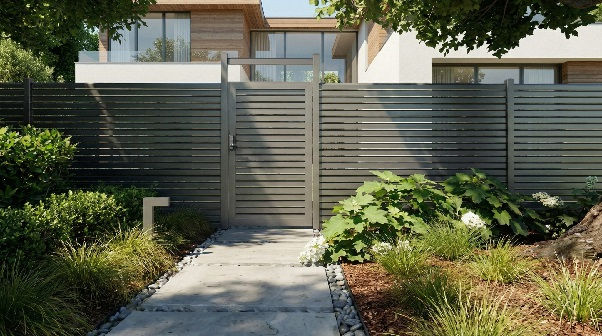
1. Composite wood-look boards.
Design range:
High. Available in horizontal and vertical layouts with a wood grain texture. Color options typically include warm wood tones rather than white or tan, which fits contemporary residential contexts better than standard vinyl. The visual character reads as natural rather than synthetic.
Maintenance:
Very low. No painting, no staining, no rot. UV-protected composite holds its color without treatment.
Gate matching:
Strong, when the gate frame is designed to accept the same boards as the fence. Verify this before purchasing.
Best fit for:
Homeowners who want to move away from vinyl's aesthetic while keeping the low-maintenance performance. The closest design upgrade from a wood-look vinyl to a genuinely wood-look modern fence system.
2. Steel privacy panel systems.
Design range:
Contemporary and architectural. Wide panels in a vertical configuration with a matte powder-coat finish in dark tones. Not a wood look, but a strong contemporary alternative that's distinct from vinyl's residential character.
Maintenance:
Very low. Steel with proper coating holds its surface without treatment. Non-combustible material for fire zone applications.
Gate matching:
Strong when gate frames are designed for the same panel infill. The gate reads as part of the same system.
Best fit for:
Homeowners who want a clear departure from vinyl's aesthetic, or who have fire zone requirements that vinyl doesn't meet.
3. Aluminum slat systems.
Design range:
Architectural and open. Horizontal slats with consistent spacing give a contemporary fence line that's distinct from both vinyl and wood-look composites. The open design allows airflow alongside privacy.
Maintenance:
Very low. Aluminum doesn't rust in the way steel can and requires minimal upkeep.
Gate matching:
Strong when included in the same fence system.
Best fit for:
Homeowners who want a modern architectural look with airflow, in a contemporary residential or designed outdoor space.
Modern Yard's options for a vinyl replacement
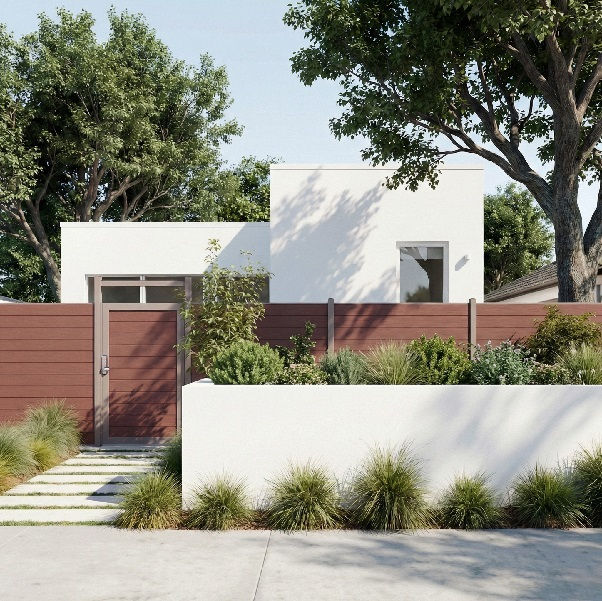
myRedwood composite fence. The closest design upgrade from vinyl.
The myRedwood system is the most direct replacement for a homeowner moving away from vinyl toward a wood-look aesthetic with modern design sensibility. Tongue-and-groove boards in 60% natural wood fiber and 35% recycled plastic, with a 360° UV-protected PE wrap on all four sides. Available in horizontal and vertical layouts. The horizontal layout in particular delivers the contemporary fence character that vinyl profiles can't achieve.
Matched aluminum gate frames accept the same composite boards as the fence, maintaining visual continuity through the gate opening. Aluminum hinges packaged with the gate frame. Pre-drilled lock mount for the myLock-Combination. 25-year limited warranty.
FireGuard steel fence. For privacy with fire performance.
The FireGuard system replaces vinyl's maintenance-free performance with a steel panel system that adds fire resistance the vinyl category can't offer. Wide interlocking steel panels in a sophisticated gray-black tone, ASTM E84-24 Class A certified, listed on the California Fire Safe Council Vendor List. The same finished appearance on both sides. Matched aluminum gate frames. 25-year limited warranty.
Best fit for California fire zone projects, HOA communities that require contemporary aesthetics and consistent appearance on both sides of the fence, or any project where vinyl's combustibility is a disqualifying factor.
MyAir aluminum fence. For a contemporary open look.
The myAir system replaces vinyl's solid-panel logic with a horizontal slat design that delivers 100% privacy from straight-on angles with up to 33% open area. Tap-in wedge spacing connectors ensure consistent slat intervals. Spans up to 8ft between posts. Matched gate frames. 25-year limited warranty.
Best fit for homeowners who want to move decisively away from vinyl's visual character toward an architectural fence that reads as a designed element rather than a standard perimeter marker.
All three systems use the same Modern Yard slotted steel post, which means a project that incorporates more than one system across different sections maintains a consistent post profile throughout.
Choose the material that solves the problem vinyl created
Vinyl solved wood maintenance. The alternatives that make sense now are the ones that solve vinyl's remaining problems: limited design range, brittle performance in cold climates, and weak gate systems. The right replacement depends on which of those limitations is the primary driver. Installation guides for all three Modern Yard systems are at the installation guides page.