
ASTM E84 Class A Fire-Resistant Fence: What the Rating Means and Which Products Are Actually Tested
A lot of fence products claim fire resistance. Fewer can support that claim with a third-party test report.
ASTM E84 Class A is the standard most frequently cited in fire-rated fence specifications, but the gap between a product that claims Class A compliance and one that has a verified, downloadable test report from an accredited laboratory is significant.
For homeowners in WUI zones, fire-prone regions, or HOA communities with material requirements, that gap can mean the difference between a product that qualifies and one that may not.
This guide explains what ASTM E84 Class A actually measures, what documentation to request, and where Modern Yard’s FireGuard system stands within that framework.
At a glance
ASTM E84 Class A is the highest surface burning classification under the standard, requiring a Flame Spread Index of 25 or less and a Smoke Developed Index of 450 or less. For fence products, the meaningful distinction is between brands that claim this rating and those that have a publicly available third-party test report confirming it.
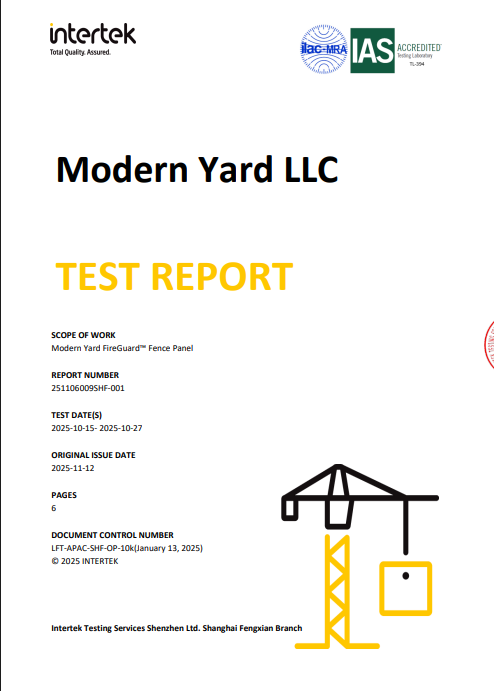
Modern Yard's FireGuard steel fence system is certified under ASTM E84-24, with a downloadable Flame Spread Index test report available at the Modern Yard warranty and test reports page. The FireGuard system is also listed on the California Fire Safe Council (CFSC) Vendor List.
What ASTM E84 actually measures
ASTM E84, formally titled the Standard Test Method for Surface Burning Characteristics of Building Materials, measures how a material behaves when exposed to flame along its surface. The test produces two numbers:
Flame Spread Index (FSI). How quickly flame travels across the surface of the material during the test. Lower is better.
Smoke Developed Index (SDI). How much smoke the material produces during burning. Also lower is better.
The classification thresholds are:
Class A. FSI of 0 to 25, SDI of 0 to 450. The most restrictive classification. Required by many building codes and fire zone regulations for materials in high-risk areas.
Class B. FSI of 26 to 75. A middle tier that meets general building code minimums in many jurisdictions but does not satisfy Class A requirements.
Class C. FSI of 76 to 200. The least restrictive classification under this standard.
For fence applications, Class A matters most in WUI (Wildland-Urban Interface) zones, fire hazard severity zones designated by CAL FIRE, and HOA or insurance requirements that specify non-combustible or fire-resistant materials. A Class B product does not substitute for a Class A requirement, and the two are not interchangeable in permit or insurance documentation.
Worth knowing. ASTM E84 tests surface burning characteristics, not structural integrity under fire exposure. A Class A rating means the material resists flame spread and limits smoke production. It does not mean the material is non-combustible or will hold its structure in a direct fire event.
The difference between a claim and a verified test report
In the fence industry, fire resistance claims fall into roughly three categories:
Unverified claims.
A product page states "fire-resistant" or "Class A rated" with no supporting documentation, no test number, and no named testing laboratory. These claims cannot be independently verified.
Partial documentation.
A brand provides a test report number or references a testing lab but does not make the full report available for download. Verification requires contacting the lab directly.
Publicly available third-party test reports.
The brand publishes the full test report as a downloadable PDF, including the testing laboratory, test date, sample description, FSI and SDI results, and the specific ASTM standard version used. This is the highest level of transparency and the only form of documentation that can be independently reviewed without additional contact.
When specifying materials for a WUI project, permit application, or HOA submission, the third category is the only one that holds up to scrutiny. A claim is not documentation. A report number without a downloadable PDF leaves verification work to the specifier. A full published report lets the material stand on its own.
What to ask before specifying a fire-resistant fence
These questions apply to any fence product being considered for a fire-sensitive project.
Is there a third-party test report, and can I download it? Not a product page claim. An actual PDF from an accredited testing laboratory showing FSI and SDI results against a specific ASTM version.
Which version of ASTM E84 was used?
The standard is updated periodically. Knowing the version (e.g., ASTM E84-24) confirms the test was conducted against a current standard, not an older iteration.
What specifically was tested?
The test report should identify the exact product and configuration tested. A fence panel in one configuration may perform differently from the same panel in a different installation.
Is the product on the California Fire Safe Council Vendor List?
For California projects, CFSC listing is an additional verification layer that indicates the product has gone through CFSC's review process for fire-safe materials. It's not required outside California but is a meaningful signal of compliance rigor.
Does the warranty cover the fire-resistant performance?
Some brands warrant the structural product but not the coating or treatment responsible for fire performance. Verify that the warranty covers the material properties relevant to fire resistance.
Modern Yard FireGuard: what the certification covers and where to find the report

The Modern Yard FireGuard system is a steel fence panel system certified under ASTM E84-24, the current version of the standard. The certification covers the surface burning characteristics of the FireGuard panel in its standard configuration.
What the documentation covers:
ASTM E84-24 Flame Spread Index Test Report.
A full third-party test report is publicly available for download at the Modern Yard warranty and test reports page. The report includes FSI and SDI results confirming Class A classification.
California Fire Safe Council Vendor List.
The FireGuard system is listed on the CFSC Vendor List, making it a documented option for California fire zone and WUI projects where CFSC-reviewed materials are specified.
25-year limited warranty.
Warranty documentation is available on the same page, covering the metal products in the system.
Product specifics relevant to fire applications:
Panel design. Wide interlocking steel panels, vertical orientation. The interlocking design creates a continuous surface with no gaps that could allow ember intrusion, which is a relevant consideration in WUI zone specifications.
System compatibility. The FireGuard panel works within the Modern Yard slotted post system. Three post sizes cover in-ground and on-ground installation across 3ft to 7ft fence heights.
Good neighbor design. The FireGuard panel presents the same finished appearance on both sides, which is relevant for California projects where good neighbor fence standards apply to shared property lines.
For California contractors and specifiers, the combination of ASTM E84-24 Class A certification, CFSC Vendor List status, and publicly available test documentation makes the FireGuard system one of the more thoroughly documented fence options currently on the market for fire zone applications.
Verify the report, not just the claim
Fire resistance in a fence product is only as reliable as the documentation behind it. A Class A claim on a product page requires a test report to mean anything in a permit application, HOA submission, or insurance review. The Modern Yard FireGuard test report and product documentation are publicly available for review before purchase. For projects where fire compliance is a requirement rather than a preference, that level of documentation is the starting point for material selection, not the finishing touch.